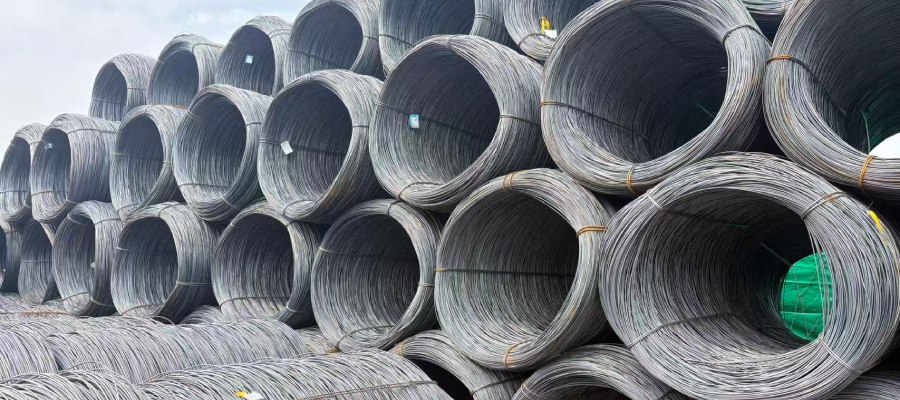



What Size Is #4 Rebar? A Simple Size Guide
When choosing steel reinforcement for concrete construction, rebar size plays a critical role in determining structural strength and durability. Among all standard rebar sizes, #4 rebar is one of the most commonly used worldwide. Many buyers, contractors, and engineers ask the same question: what size is #4 rebar?
This straightforward size guide covers all essential details about #4 rebar, such as its diameter, weight, metric equivalent, grades, and practical uses in real-world scenarios.
What Size Is #4 Rebar?
#4 rebar has a nominal diameter of 1/2 inch (12.7 mm).
In the U.S. rebar sizing system, the number refers to the diameter measured in eighths of an inch:
#4 rebar = 4/8 inch
4/8 inch = 1/2 inch (12.7 mm)
This measurement system is standardized and commonly utilized across North America and numerous global markets.
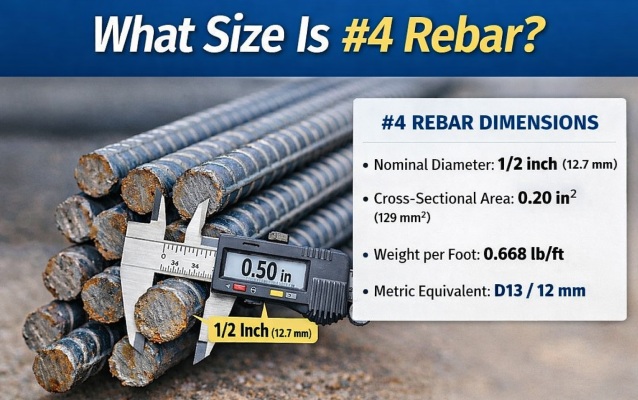
#4 Rebar Dimensions and Weight
Below are the standard physical specifications of #4 rebar:
Specification | Value |
Nominal Diameter | 1/2 inch (12.7 mm) |
Cross-Sectional Area | 0.20 in² (129 mm²) |
Weight per Foot | 0.668 lb/ft |
Weight per Meter | 0.994 kg/m |
Standard Lengths | 20 ft, 40 ft |
Surface Type | Deformed (ribbed) |
Metric Equivalent of #4 Rebar
In metric-based countries, #4 rebar is approximately equivalent to 12mm–13mm rebar, commonly labeled as D13.
Approximate comparison:
#4 rebar ≈ 12 mm / 13 mm rebar
Used extensively in Asia, Africa, and the Middle East
Because of slight differences between standards, it is always recommended to confirm project specifications before substitution.
Common Grades of #4 Rebar
#4 rebar is available in several strength grades depending on the standard:
Common Grades
Grade 40 – Yield strength 40,000 psi
Grade 60 – Yield strength 60,000 psi (most common)
Seismic Grade (A706) – Improved ductility for earthquake zones
International Standards
ASTM A615 / A706
BS 4449
AS/NZS 4671
JIS / GB standards
Grade 60 #4 rebar is predominantly utilized in both residential and commercial building projects because of its outstanding strength-to-cost efficiency.
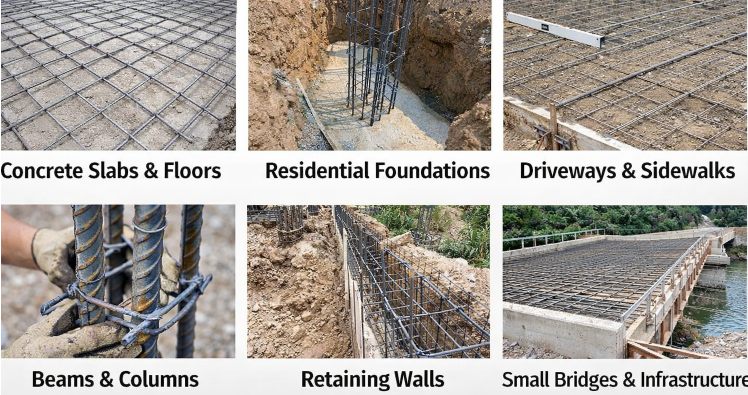
Typical Applications of #4 Rebar
Thanks to its versatility, #4 rebar is suitable for a wide range of construction projects.
Common uses include:
Concrete slabs and floors
Residential foundations
Driveways and sidewalks
Beams and columns (light to medium load)
Retaining walls
Small bridges and infrastructure projects
Its moderate diameter makes it easy to cut, bend, and install on-site.
Why #4 Rebar Is So Popular
There are several reasons why #4 rebar is one of the most frequently specified sizes:
Meets most residential building codes
Cost-effective compared to larger rebar sizes
Strong enough for many structural applications
Widely available from global rebar suppliers
Easy to handle and fabricate
For many contractors, #4 rebar provides the ideal balance between performance and efficiency.
#4 Rebar vs Other Common Sizes
Rebar Size | Diameter | Typical Use |
#3 Rebar | 3/8 in (9.5 mm) | Light slabs, patios |
#4 Rebar | 1/2 in (12.7 mm) | Slabs, foundations |
#5 Rebar | 5/8 in (15.9 mm) | Beams, columns |
#6 Rebar | 3/4 in (19.1 mm) | Heavy structural work |
#4 rebar is often selected when #3 is too light and #5 is unnecessary or too costly.
Buying #4 Rebar: What to Check
When sourcing #4 rebar, buyers should confirm:
Diameter tolerance
Steel grade and standard
Length and bundling
Surface deformation quality
Mill test certificate (MTC)
Reliable suppliers will provide full documentation and consistent quality.
So, what size is #4 rebar?
In simple terms, #4 rebar measures 1/2 inch (12.7 mm) in diameter, making it one of the most practical and widely used reinforcement bars in concrete construction.
From slabs and foundations to beams and walls, #4 rebar delivers dependable strength, easy installation, and excellent value—making it a top choice for contractors and builders around the world.