


GI Pipe Sizes: Complete Guide to Dimensions, Standards, and Applications
GI pipe (Galvanized Pipe) is widely used in water supply, plumbing, structural frameworks, agriculture, and industrial applications. Choosing the correct GI pipe size is essential for ensuring proper flow, mechanical strength, and cost efficiency.
This guide explains standard GI pipe sizes, dimensions, weights, applications, and selection tips, helping contractors, engineers, and buyers make the right decisions.
What Are GI Pipe Sizes?
GI pipes are sized based on Nominal Bore (NB) or Nominal Diameter, which represents the approximate inner diameter of the pipe. Common sizing systems include:
- NB (Nominal Bore) – Used in India, Asia, Middle East, Africa
- DN (Diameter Nominal) – European metric standard
- Schedule (SCH) – Defines wall thickness (SCH 20 / 40 / 80)
- OD (Outer Diameter) – Fixed for each NB size
For example:
- GI Pipe 1" NB → Outer Diameter = 33.7 mm
- GI Pipe 2" NB → Outer Diameter = 60.3 mm
Although the NB remains the same, the wall thickness changes depending on Light, Medium, or Heavy class.
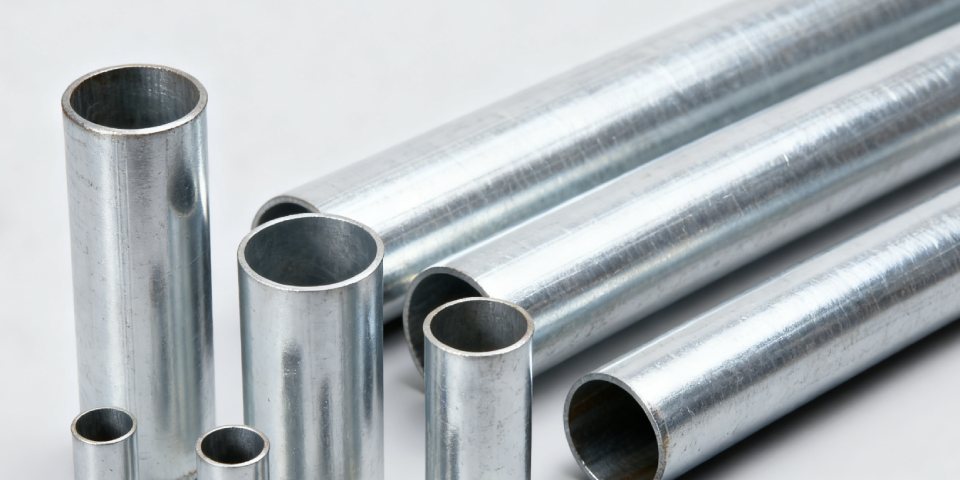
GI Pipe Size Chart (NB ½"–12")
Below is a detailed GI pipe size chart based on common standards such as IS 1239, ASTM A53, and BS 1387.
NB (Inch) | OD (mm) | Wall Thickness (mm) | Class | Weight (kg/m) |
½" | 21.3 | 2.0 / 2.65 / 3.25 | Light/Medium/Heavy | 0.95 – 1.42 |
¾" | 26.9 | 2.0 / 2.65 / 3.25 | Light/Medium/Heavy | 1.19 – 1.88 |
1" | 33.7 | 2.6 / 3.2 / 4.0 | Light/Medium/Heavy | 1.60 – 2.33 |
1¼" | 42.4 | 2.6 / 3.2 / 4.0 | L / M / H | 2.16 – 2.98 |
1½" | 48.3 | 2.9 / 3.2 / 4.0 | L / M / H | 2.43 – 3.57 |
2" | 60.3 | 2.9 / 3.6 / 4.5 | L / M / H | 3.58 – 5.06 |
2½" | 76.1 | 3.2 / 3.6 / 4.5 | L / M / H | 5.44 – 6.87 |
3" | 88.9 | 3.2 / 4.0 / 4.8 | L / M / H | 6.61 – 8.87 |
4" | 114.3 | 3.2 / 4.5 / 5.4 | L / M / H | 8.89 – 12.76 |
5" | 141.3 | 3.6 / 4.5 / 5.4 | L / M / H | 12.36 – 16.72 |
6" | 168.3 | 4.0 / 4.5 / 5.4 | L / M / H | 17.47 – 22.16 |
8" | 219.1 | 4.5 / 6.3 | M / H | 27.89 – 37.44 |
10" | 273.1 | 4.5 / 6.3 | M / H | 34.30 – 48.22 |
12" | 323.9 | 4.5 / 6.3 | M / H | 40.72 – 57.70 |
(Note: GI pipes above 12" are less common and often custom-manufactured.)
Need GI pipes? Shineyond Group supplies full-size ranges with factory-direct pricing—contact us for a quote.
Click here to buy galvanized steel pipes
Types of GI Pipe Thickness (Class A / B / C)
Class | Wall Thickness | Description | Applications |
Light (A-Class) | Thin | Economical, low-pressure use | Agriculture, fencing,light structures |
Medium (B-Class) | Medium | Standard pressure | Water supply, plumbing,general construction |
Heavy (C-Class) | Thick | High strength & pressure | Firefighting, borewells, industrial piping |
Rule: Higher class = stronger and heavier = more expensive.
Common Applications of GI Pipes by Size
GI Pipe Size | Typical Uses |
½" – 1" | Domestic water lines, small plumbing, GI conduit |
1¼" – 2" | House connections, irrigation, structural frames |
2½" – 4" | Water mains, fire protection, factory piping |
5" – 6" | Industrial flow systems, building risers |
8" – 12" | Large water distribution, infrastructure & construction |
Pro Tip: For structural and scaffolding use, choose sizes 1¼" (42mm), 1½" (48mm), and 2" (60mm)—these are the most common.

How to Select the Right GI Pipe Size
When choosing a GI pipe, consider the following factors:
✅ 1. Flow Requirement
Larger diameter = higher water flow rate.
✅ 2. Pressure Level
Choose Medium or Heavy class for high-pressure applications.
✅ 3. Usage Scenario
Plumbing: ½" to 2"
Structural: 1¼" to 2"
Water lines: 2" to 6"
Industrial: 6" and above
✅ 4. Local Standards (IS, ASTM, BS1387)
Always follow relevant building codes and project specifications.
Pro Tip:
For most residential water supply systems, 1"–2" Medium Class GI pipes work best.
FAQs About GI Pipe Sizes
Q1: What does NB mean in GI pipe sizes?
NB stands for Nominal Bore—the approximate inside diameter of the pipe.
Q2: Is GI pipe measured by ID or OD?
GI pipes are designated by NB, but the outer diameter (OD) is fixed, and wall thickness varies.
Q3: What is the most common GI pipe size?
1" to 2" NB is the most commonly used range for plumbing and construction.
Q4: What’s the difference between Light, Medium, and Heavy class?
They indicate wall thickness—Heavy class is the strongest and most durable.
Q5: Can GI pipes be used for drinking water?
Yes—GI pipes are galvanized to prevent corrosion and are suitable for water supply lines.
Need GI Pipes? Contact Shineyond Group
We supply full-size GI pipes including:
½"–12"
Light / Medium / Heavy class
IS 1239, ASTM A53, BS 1387 standards
Hot-dipped galvanized and pre-galvanized options
Factory-direct price. Fast delivery to Africa, Asia, Middle East.